Give the jar a job

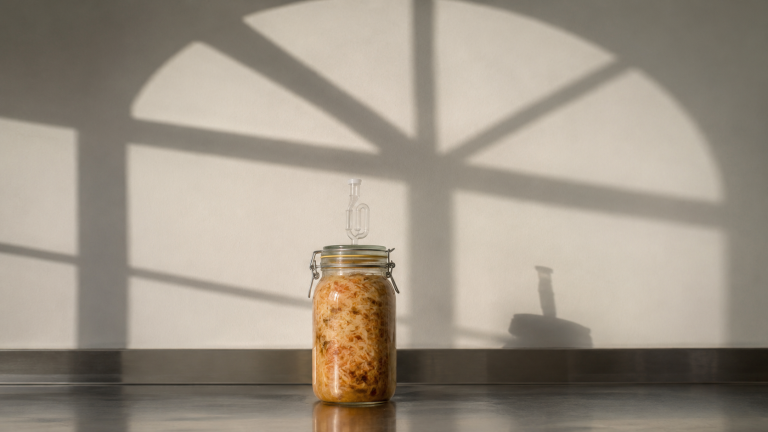
There is a jar at the back of your fridge with three centimetres gone from the top. You bought it on purpose. You have not been able to think of a reason to open it since.
That is not a discipline problem. The jar arrived without a job.
An ingredient with no job goes to the back
Every ingredient on a professional line has a place it is used and a moment it is used at. Not because kitchens are tidy, but because anything without a station gets pushed behind something with one, and then it is a Tuesday and you are throwing it out.
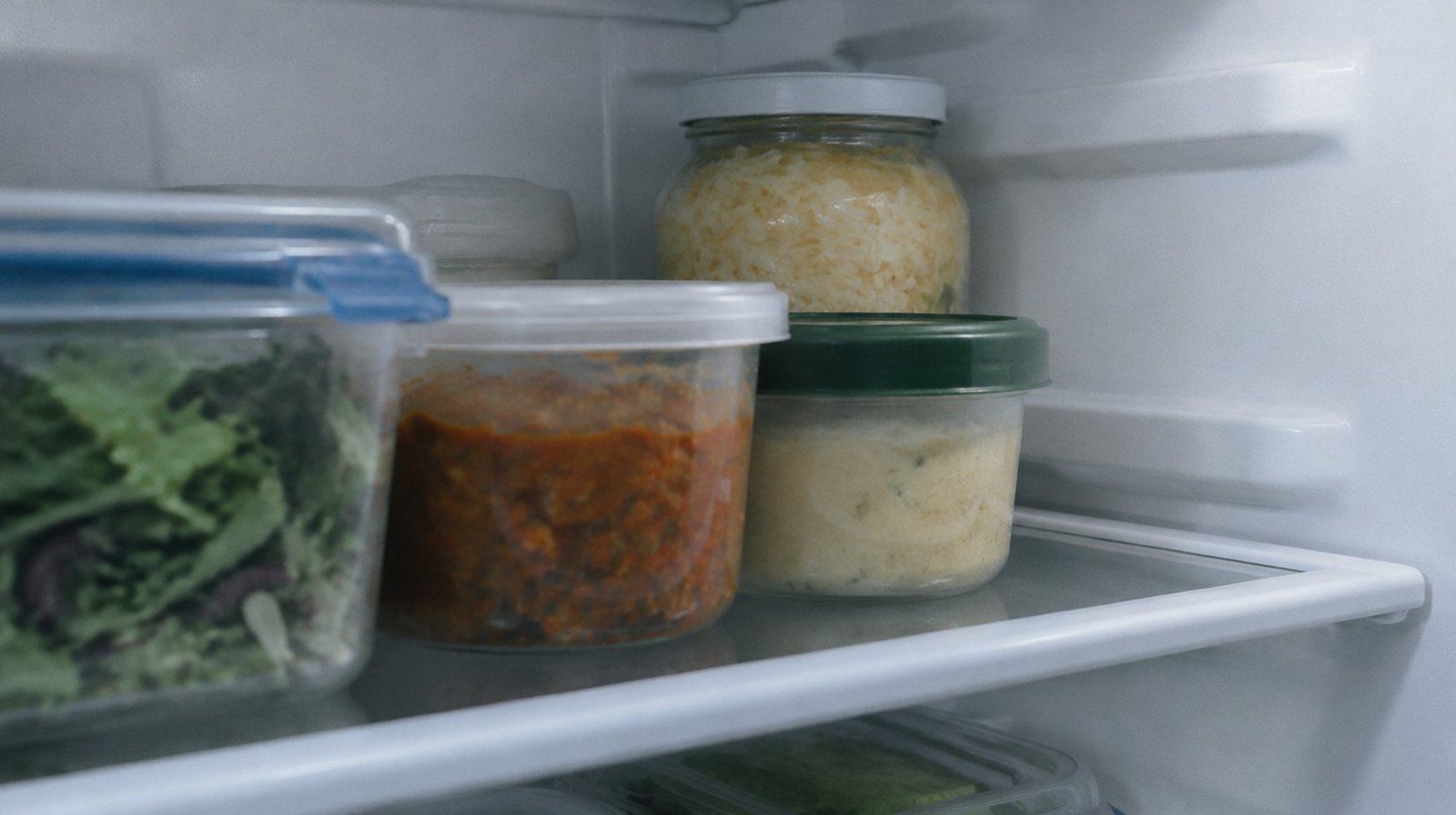
A domestic fridge runs the same way. The jar is competing with things that have a clear destination, and it loses every time.
The label will not fix this. A label is very good at telling you what is in the jar and how to store it once opened, and both of those matter. Neither of them tells you what the cabbage is for on Wednesday.
So the question is not whether to eat more fermented food. It is narrower and much easier: which meal that you already cook has a gap this could fill.
What the habit research actually says
Phillippa Lally and colleagues ran the study most often quoted on this, and it is quoted for the wrong number.
Ninety-six volunteers each chose one eating, drinking or activity behaviour and carried it out daily. The instruction was not to do it more often. It was to do it in the same context, and the example the researchers gave was “after breakfast”.
They reported on automaticity every day for twelve weeks. Eighty-two gave enough data to analyse, and for sixty-two the model fitted.
The finding is that repeating something in a consistent setting is what builds automaticity, and it does it on a curve. Early repetitions buy you the most. Later ones buy less, until more repetition stops adding anything.
Now the number. Time to reach 95 percent of an individual’s own plateau ranged from 18 to 254 days.
That is not a number you can put on a poster, which is why the internet invented twenty-one and then sixty-six. Both are wrong, and the spread between eighteen days and eight months is the actual result.
There is one more finding and it is the one worth keeping. Missing a single day did not materially affect the process. The researchers compared gains across two consecutive days against two days with a miss in between, and the curve carried on.
Consistency over perfection is a thing we say around here. It turns out somebody measured it.
Give it one job, at one meal
So: one jar, one meal, one job. Not a plan for the week.
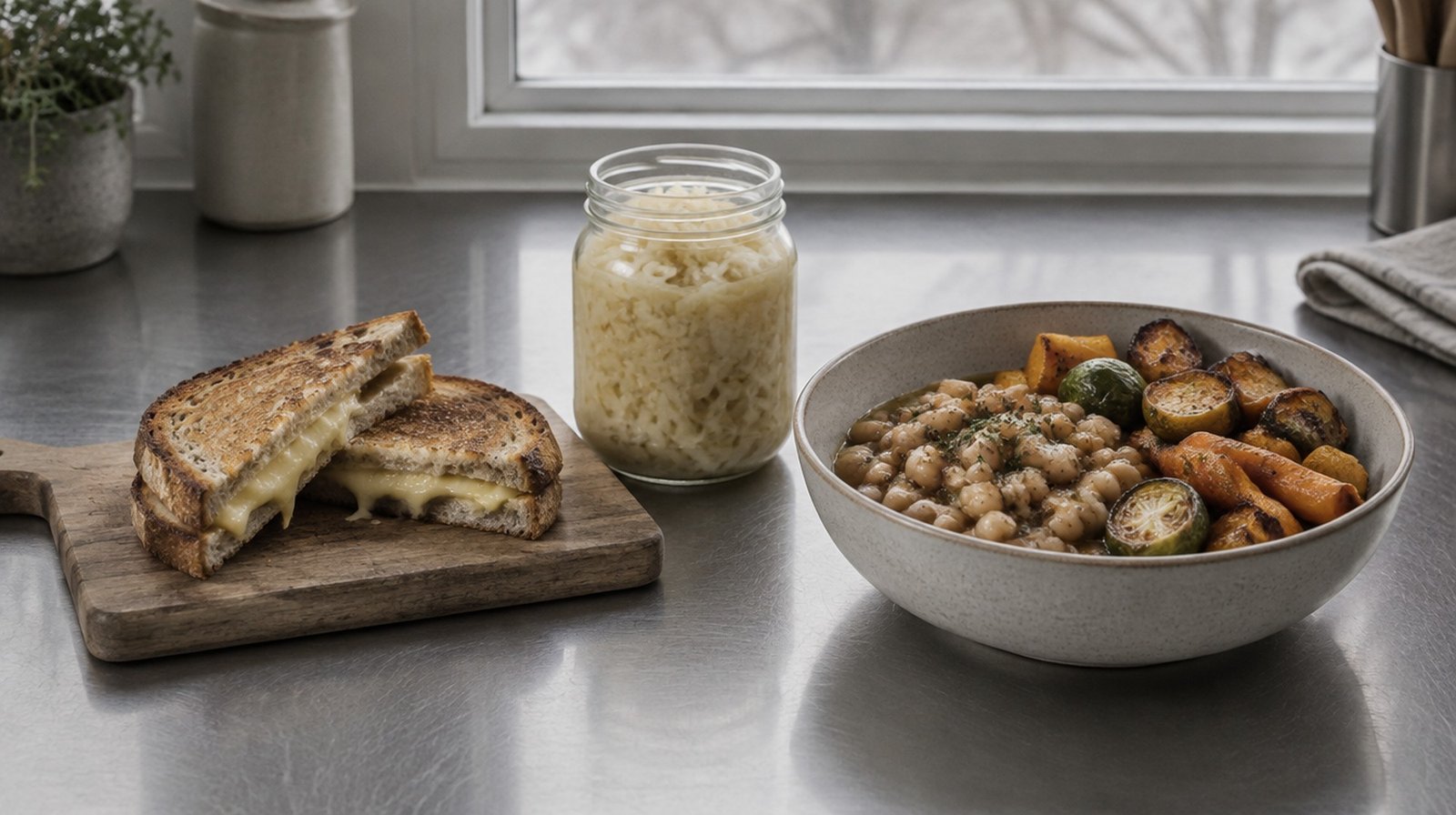
Pick the meal first, and pick one you make without thinking. A cheese sandwich, a bowl of beans, eggs on a Saturday, a baked potato. The point of choosing something habitual is that it supplies the consistent context, which is the part doing the work.
Then decide what the meal actually needs. Sharpness, crunch, heat, or a savoury note. That is a seasoning question, and it has a real answer.
Taste it before you commit. One mouthful of the meal as it stands, one with the ferment on the fork. If it does nothing, the answer is not more of it, the answer is a different meal.
Finding out that a jar does nothing for beans is a useful result. It costs one mouthful and it saves you the other four hundred grams.
Keep the plan small enough to remember. “Sandwich, and the bean bowl” is a plan. A colour-coded week is a project, and Lally’s own data has complex behaviours reaching lower automaticity than simple ones.
Store it as the label directs, and follow that jar’s after-opening instructions rather than a rule you read somewhere. If writing the opening date on the lid helps you follow those instructions, write it. A date you invented does not extend the window the manufacturer set.
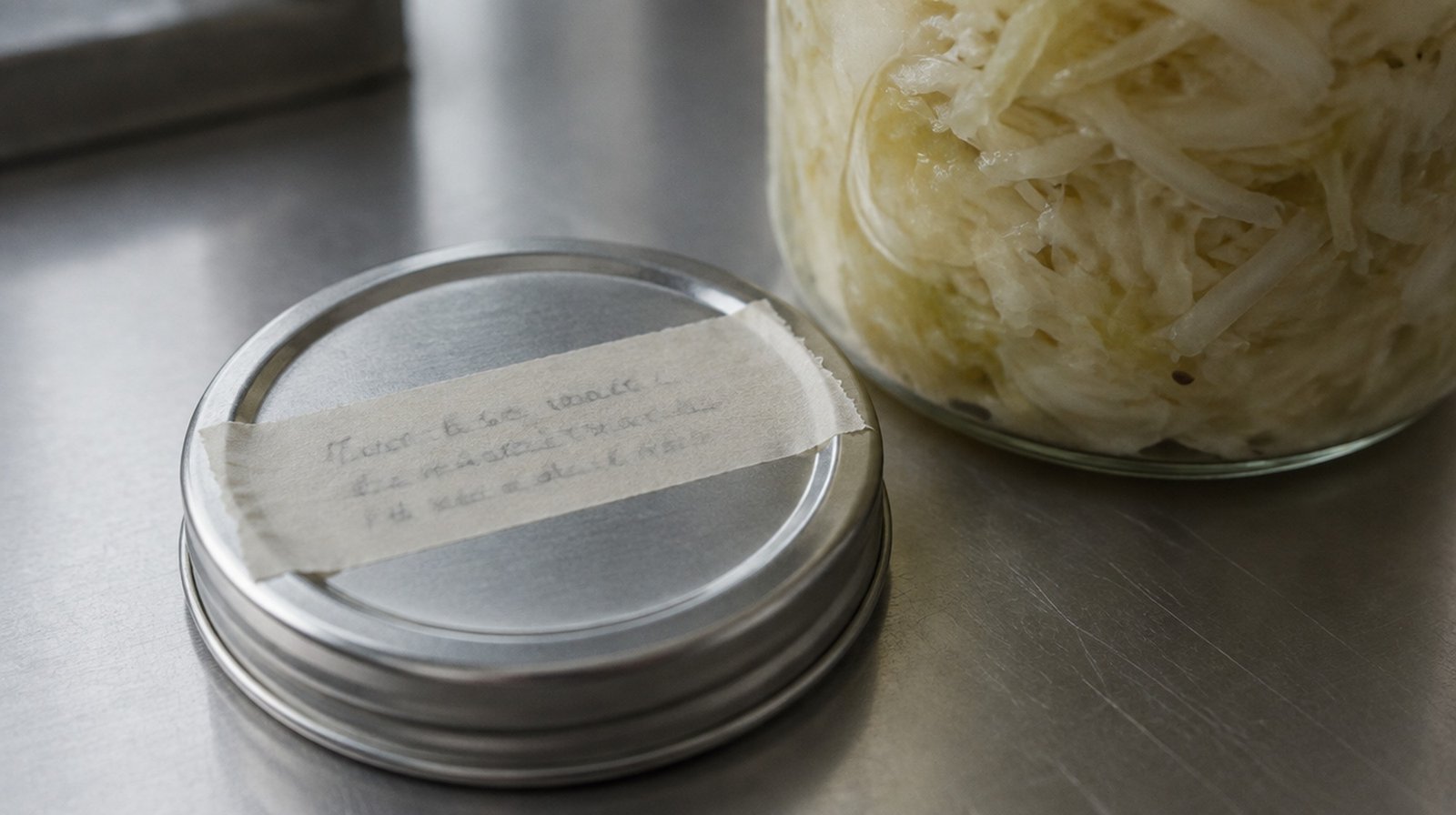
The note that makes the next jar easier
Leave yourself four words about how it tasted. Crisp. Very sharp. Good with beans. Too hot for the sandwich.
Those describe the food, which is what the next purchase actually needs. They are worth more than an account of what the jar supposedly did inside you, and they are the only record that gets better with use.
Buy the small one until you have that note. After three or four meals you will know whether the big jar is value or landfill, and you will know it from evidence rather than intention.
And once a finished ferment has an established place in your kitchen, the question of making your own becomes a real one instead of an abstract one. You will know which food you want, where it gets served and how fast you get through it, which is a proper brief. If you go that way, use a tested recipe from a proper preservation source and follow the whole method, because that is a separate skill and it deserves its own attention.
That is the month. Read what the label is entitled to claim. Notice what you actually ate. Keep the size of a trial’s result honest. Then give one jar one job in one meal, and let the eighteen to two hundred and fifty-four days take as long as they take.
References
4 sources, with what each one covers
Lally P, van Jaarsveld CHM, Potts HWW, Wardle J. How are habits formed: modelling habit formation in the real world. European Journal of Social Psychology, 2010;40(6):998 to 1009. DOI 10.1002/ejsp.674. Published online 2009. Human study, 96 volunteers, 82 analysed, 12 weeks. Time to 95 percent of individual asymptote ranged 18 to 254 days. Verified on scite 17 September 2026, no editorial notices, 83 supporting and 6 contrasting citations of 1618.
Food Standards Australia New Zealand. Labelling information for consumers, and allergen labelling. Consumer guidance on what a label carries.
Food Standards Australia New Zealand. Use-by and best-before dates. Date marks and accompanying storage instructions.
National Center for Home Food Preservation, University of Georgia. Fermenting. Tested home-preservation guidance. Not a chamber vacuum validation and not a substitute recipe.

Field Notes Weekly
One Field Note. Every Monday. Mechanism first, no wellness language.